PaT Lite: Key aspects of PaT you need to understand
Important Building Blocks that help us build a stunning culture
On this page
- Step 1 · Inside PaT: The 3 Pillars & the
- Step 2 · Why These Pillars Matter to You
- Step 3 · How we manage these in PaT
- Step 4 · Remember This: www.patcmp.com
- Step 5 · The Building Blocks of PaT
- Step 6 · LMS — Learning Management System
- Step 7 · PaT Chat - it's time to break up with email
- Step 8 · PaT Tasks — Get #$%^ Done
- Step 9 · PaT Tasks — Get #$%^ Done
- Step 10 · Strategy Documents (SDs) — A New Way to Work
- Step 11 · SD – Crash Course
- Step 12 · The SD — PaT’s Most Powerful Building Block
Step 1 · Inside PaT: The 3 Pillars & the
Important Building Blocks that help us build a stunning culture
Step 2 · Why These Pillars Matter to You
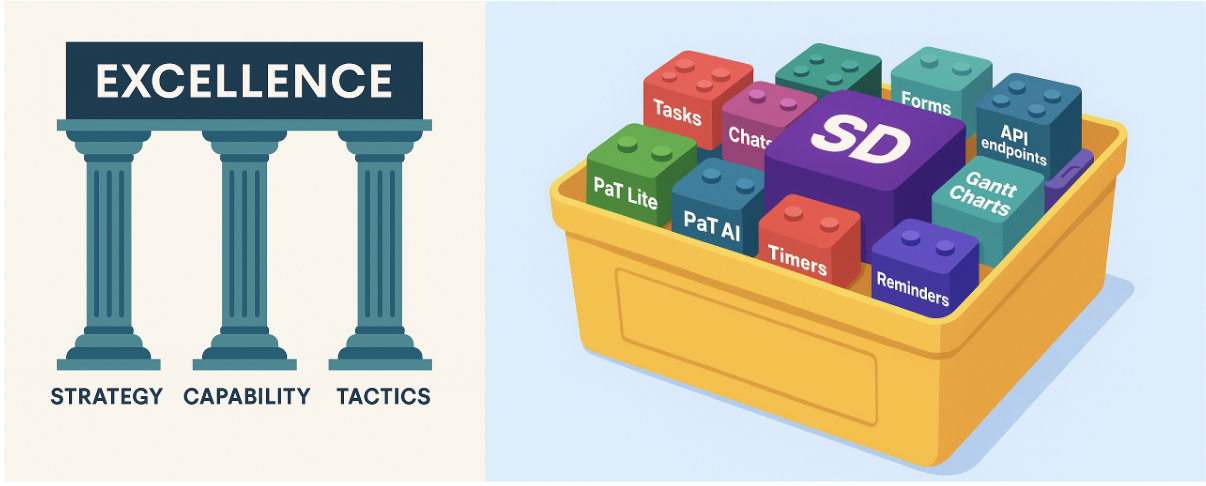
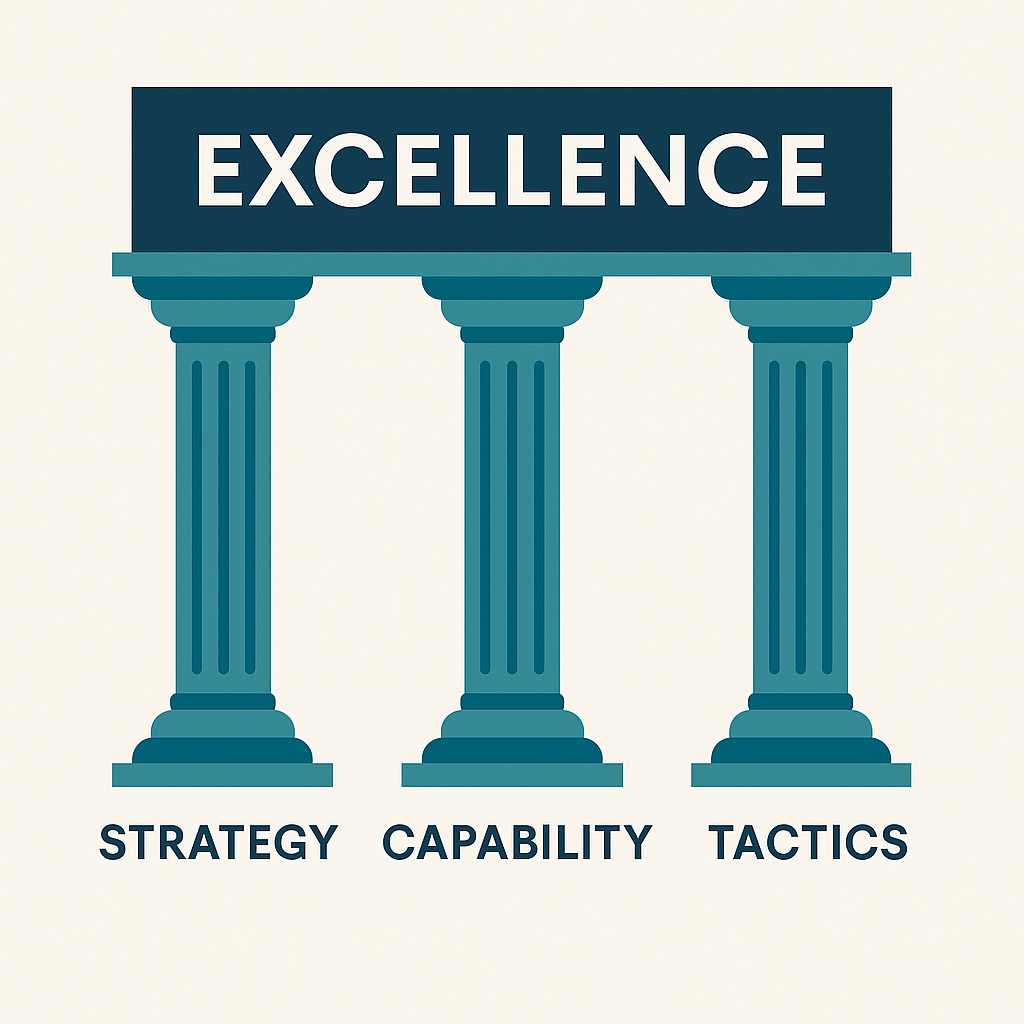
Strategy, Capability, and Tactics aren’t abstract ideas — they’re the foundation of every high-performing business, sports team, military unit, creative achievement, personal and professional relationship in history.
- Strategy (the plan) keeps everyone clear on priorities.
- Capability building skills and confidence through training to develop elite teams.
- Tactics how we execute our work, manage tasks and elevate our communication.
By unifying these business process within a single platform we eliminate the fragmentation of systems which quietly kill culture through a 1000 cuts. This unification also allows us to standardize and align our goals whilst providing unrivalled visibility as to how we are tracking. These pillars are not unique to PaT though they do hold up what every high performing team is aiming for: Excellence. What is unique is how PaT manages the underlying business systems that support these pillars to help us create a brilliant culture.
Step 3 · How we manage these in PaT
Strategy (the plan) PaT structures your business into Business Units — from the Enterprise level, through departments, countries, and areas of responsibility. Each primary Business Unit is supported by an interconnected set of Business Strategies, all built using our proprietary SD (Strategy Document), which you’ll see in this demo. These Business Strategies form the foundational backbone of the business and the culture we want to create. Capability (learning) sWe also use SDs to manage individual capability. Each team member has a PAR (Performance Agreement Review) — a two-way document capturing expectations, commitments, HR communication, coaching, and development. This connects directly to PaT’s LMS, where role-based training and instructional modules show “what good looks like” and link back to the Job Description and PAR. PARs, JDs and LMS modules are all built and managed using SDs Tactics (doing the work) Execution is driven through the PaT Task Engine — Like PaT chat, PaT Tasks are deeply integrated features of SDs. The ability to convert workinstructions into tasks is how we align people to the strategy, drive daily action, and provide real-time dashboards so leaders can track progress, remove roadblocks, and adjust quickly to deliver outcomes on time.
Step 4 · Remember This: www.patcmp.com
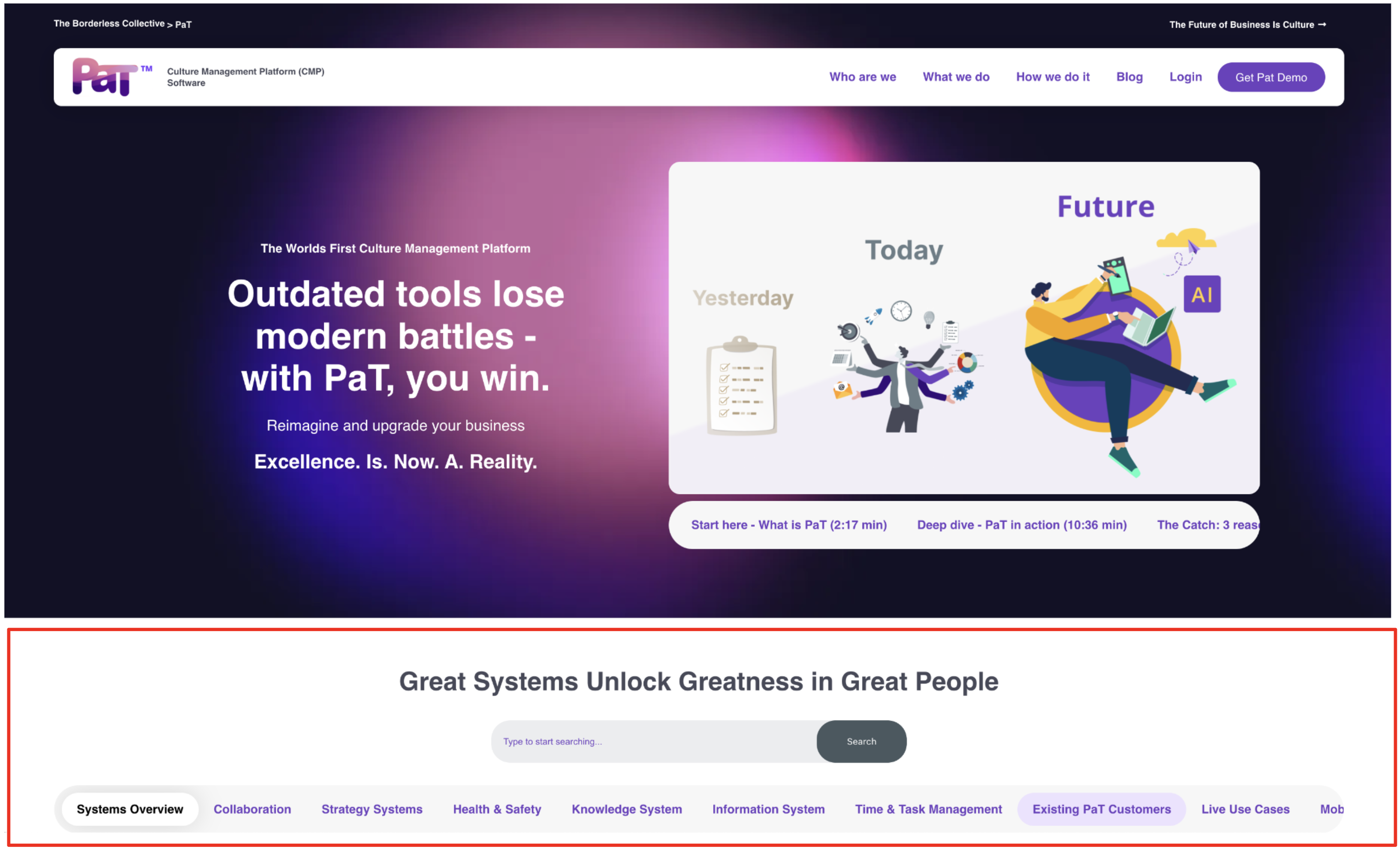
People who grow the fastest in their careers all share one habit: they master the tools that make them effective. PaT is one of those tools. The website gives you the shortcuts, techniques, and insights that experienced users rely on to work better, solve problems faster, and deliver more value. You can stumble through and eventually learn PaT by trial and error, or you can use this site and learn in a fraction of the time. It teaches you not just how to use PaT, but how to use it well — the kind of mastery that sets professionals apart. Visit the site often. Use it to sharpen your skills. Every minute you invest here pays off in confidence, speed, and career growth. www.patcmp.com — master the platform, elevate your performance.
Step 5 · The Building Blocks of PaT
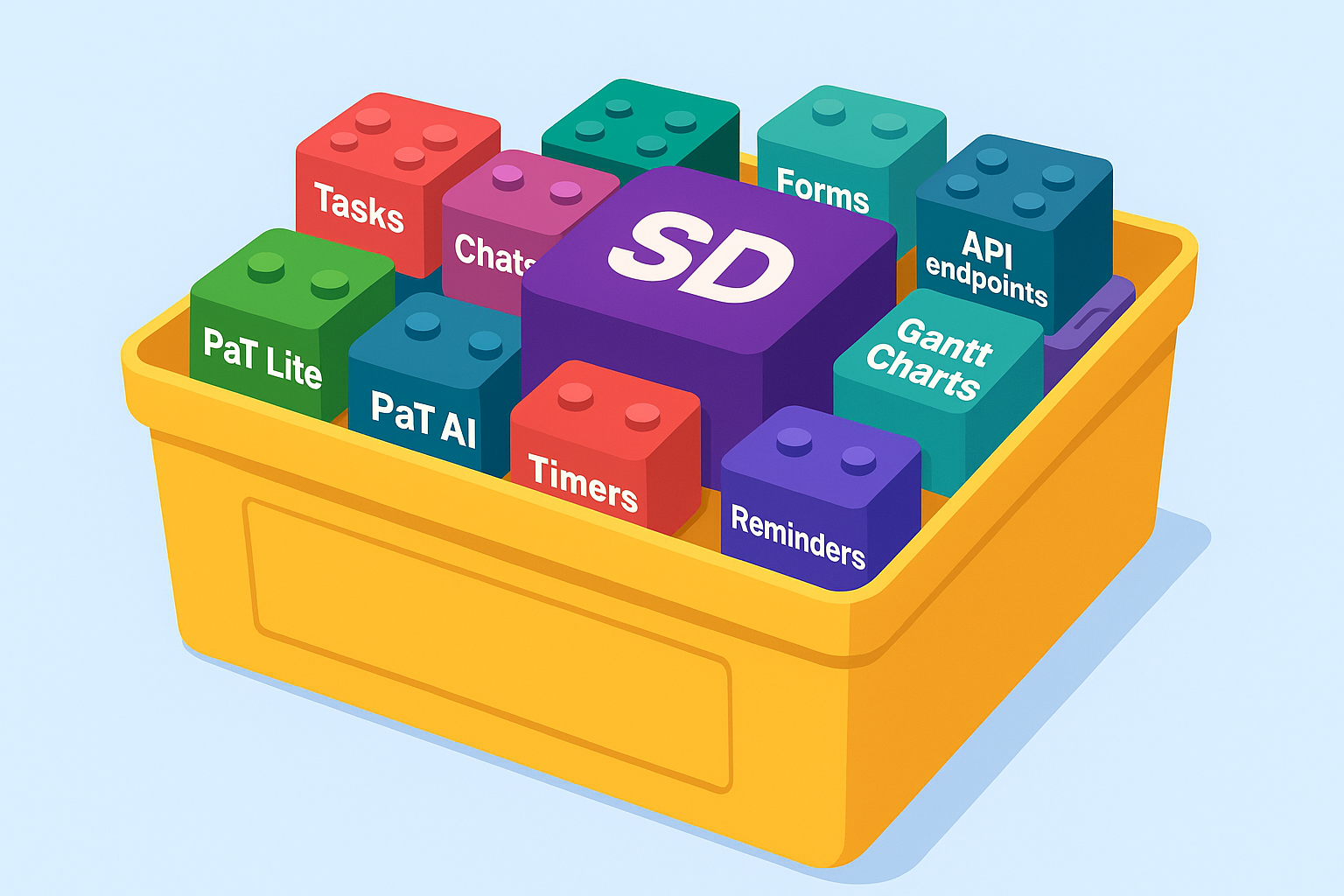
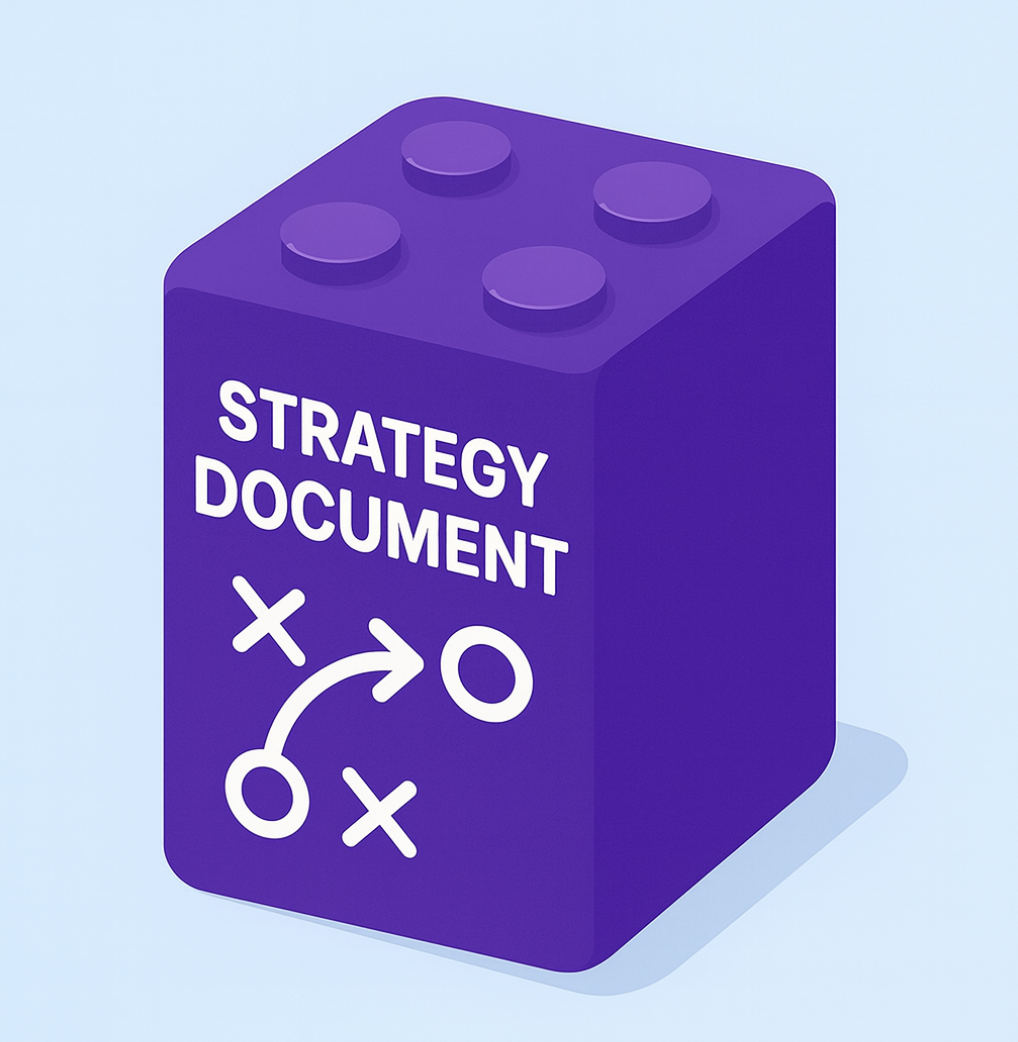
A good way to think about the business systems in PaT is like a box of Lego. PaT comes pre-bundled with over a dozen business-critical apps: some work as stand-alone blocks (like PaT Chat), while others connect together to form advanced systems — such as a Business Strategy system to drive the business forward or a PIP (Personal Improvement Plan) to support staff in advancing their careers. Beyond this you can mix and match blocks and build other systems e.g. maybe you need a ticketing system or CRM, this ability to assemble systems that "talk" to each other within a single platform without needing to learn code saves companies tens or even hundreds of thousands in licensing fees. And because all the blocks live inside the same platform, you can create more advanced solutions than a single app that does just one thing well but doesn't play nicely with others. Best of all, the blocks are reusable. As users master the foundational ones — which we’ll show you next — the learning curve for adopting new systems becomes shorter and shorter.
Step 6 · LMS — Learning Management System
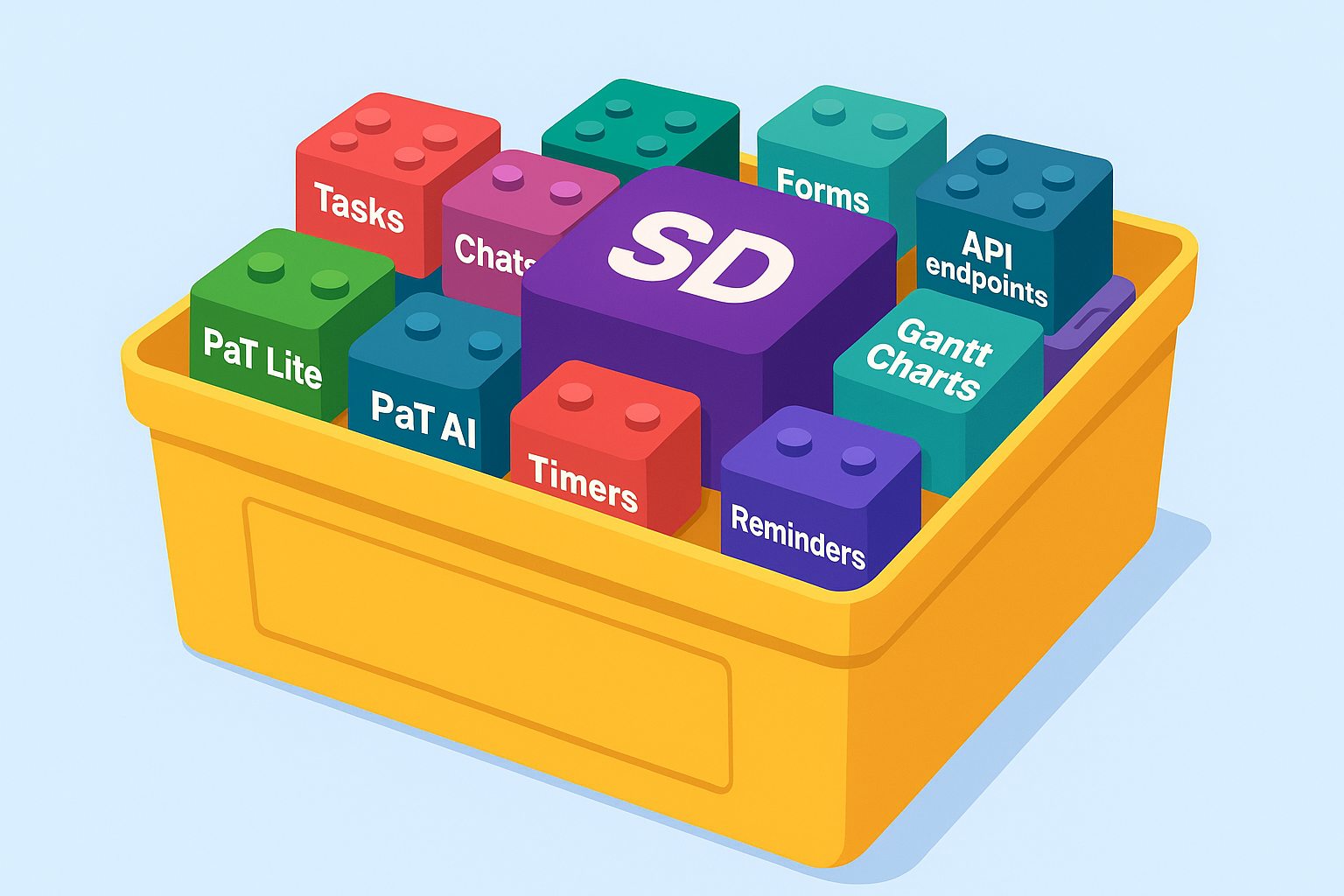
This is where your journey begins. How can anyone be expected to be great if they don’t know what great looks like? We can assume people know but that usually ends in tears. That’s why every high-performing culture — in business, sport, or the military — places such a high focus on training. PaT’s LMS (block) is different. Unlike traditional learning systems, it’s fully integrated with PaT’s Task Engine (block), so your training roadmap connects directly to the work you do. Powerful features built into the framework guarantee not just comprehension, but mastery of the skills your business needs. Some examples:
- Comprehension Audits: Beyond quizzes, PaT requires learners to prove competency in real-world scenarios before certification.
- Recertification Cycles: Because people forget over time, PaT automatically presents revision activities based on proven learning models.
- Interactive Content: PaT goes beyond static documents — students can interact with training material and with authors, surfacing questions and insights that enrich the experience for future learners which creates tribal learning.
Together, these create a powerful triple-learning paradigm — ensuring knowledge isn’t just taught, but applied, retained, and continually reinforced.
Step 7 · PaT Chat - it's time to break up with email
PaT Chat is an advanced communication platform — so much more capable than email that companies usually end up mandating it exclusively for internal comms. As digital word processing was to the typewriter it’s faster, clearer, and more effective. Users quickly find themselves wishing their customers and suppliers were on it too, because it eliminates work and reduces so much miscommunication. As you begin to experience superior outcomes, you’ll see why:
- Convert messages to tasks with a click, handing over task deadline management and subsequent follow-ups to the Task Engine.
- AI-powered assistance with ChatGPT built in — cut writing time by up to 30% and improve tone and clarity, boost your professional and personal brand.
- Contextual comms integrated throughout the platform — now you can link PaT chat 'blocks' directly to projects, customers, strategies, or tasks so nothing gets lost in personal inboxes anymore.
- Automated reminders — no more chasing people for updates; PaT does it for you.
With PaT Chat, communication doesn’t just replace email — it transforms into collaboration.
Step 8 · PaT Tasks — Get #$%^ Done
Why PaT Tasks Work PaT goes beyond traditional task management with four unique features: 1) Auto-Opt In When people are assigned work, they automatically opt in — putting the onus on them (the task assignee) to think about how it fits into their schedule. If the deadline isn’t achievable, it’s on them to work with the task assignor to propose a realistic one. This subtle feature has a profound impact on elevating task management capability. 2) Deadline Negotiation Like a game of tennis, PaT encourages back-and-forth until both sides lock in a realistic deadline. The golden rule: if you can’t meet a deadline, that’s OK — but you must renegotiate it before the deadline. This keeps the business adapting in real time instead of suffering silent failures.
Step 9 · PaT Tasks — Get #$%^ Done
Accountability Built In PaT makes accountability visible and automatic — so nothing slips through the cracks. 3) Auto-Escalation If a deadline is missed without negotiation there are consequences, PaT automatically lowers the assignee’s Task Integrity Score and spins up a task for the supervisor. Ignoring deadlines isn’t an option — transparency and communication are the expectation. 4) Task Integrity Rating Maintaining 100% task integrity is important and very simple for an organised person to do, when everyone gets here the company starts to soar: simply check your tasks daily and proactively flag deadline issues if they arise. That’s it. Professionals do this instinctively — PaT makes this process visible and helps people without a mature planning discipline - develop one.
- Those who struggle managing this one discipline frequently display a victim mentality, blaming other factors while unintentionally creating silent failures that drag companies down and errode culture. PaT ends this unprofessional behaviour by putting a spotlight on it, helping individuals grow stronger in their roles.
The result? Teams that adapt in real time, surface problems early, and actually get #$%^ done.
Step 10 · Strategy Documents (SDs) — A New Way to Work
A new way to communicate, educate, report, and visualise data for your business. SDs (Strategy Documents) are a unique document type only available in PaT. Like Word, PowerPoint, email, or spreadsheets, they can present text, images, and video — and in many cases, they replace those traditional tools. What makes SDs different:
- Database-connected: Unlike emails and word documents that live boring lives stuck in folders, every SD is powered by live data, unlocking automation and real-time insights.
- Modular: SDs connect with PaT Chat, PaT Tasks, and even other SDs — turning documents into workflows that do work for you.
- Secure by design: permissions are built into each SD, managed through PaT’s organisational-wide SD Map, so security is simple and reliable.
You’ll see SDs everywhere in PaT: for meeting minutes, project management, business strategies, and personal improvement paths that help you grow your career.
Step 11 · SD – Crash Course
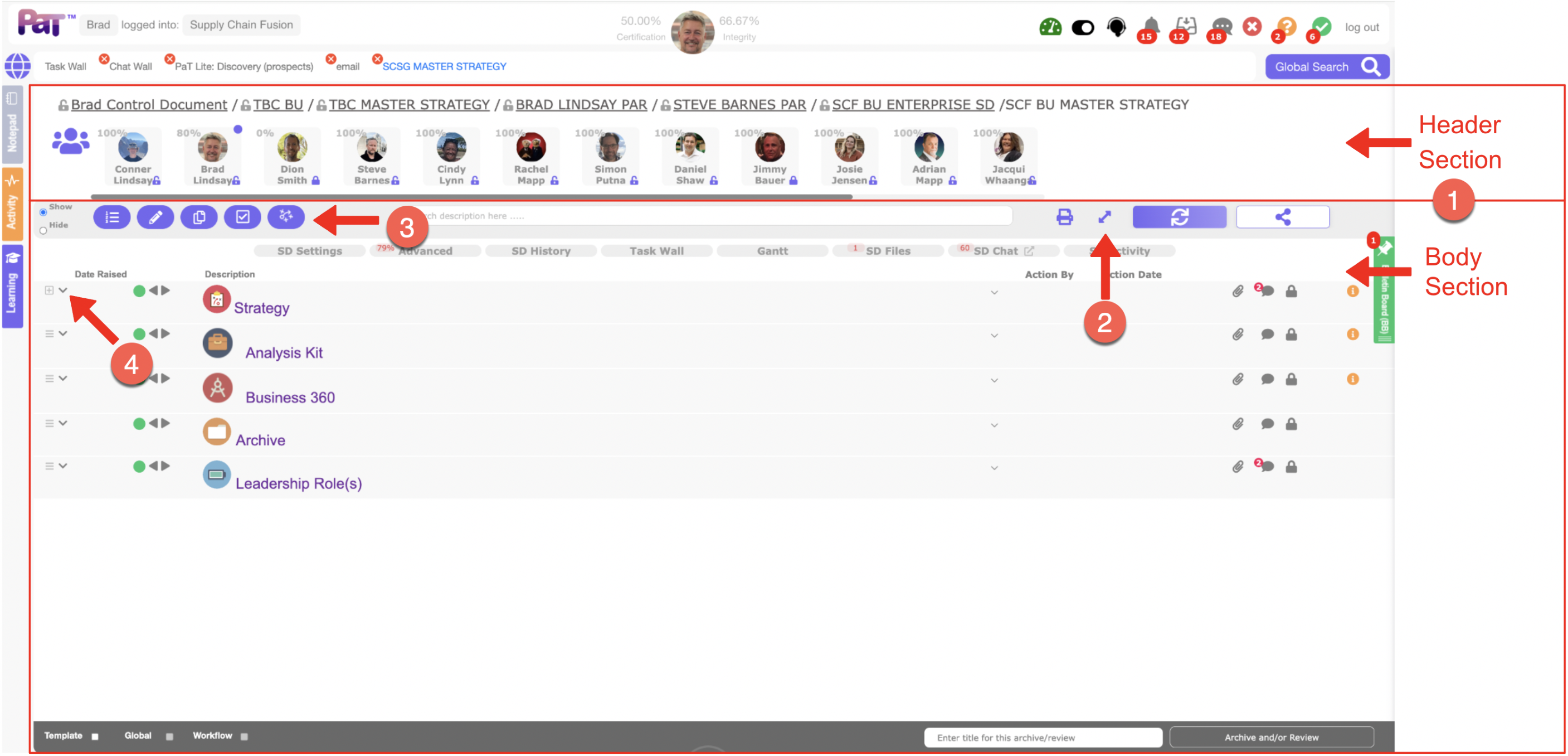
Match the numbers below with the numbers on the image above.
- Two Panels — every SD has a header and a body.
- Header Toggle — click the double arrow to show/hide the header for more screen space.
- SD Elements — drag and drop into the body to build your SD: text, section headers, tasks, images, videos, even other SDs.
- Section Headers — arrows show hidden content beneath; click to expand or collapse.
That’s it — you’ve just learned about 70% of what’s needed to manage an SD!
Step 12 · The SD — PaT’s Most Powerful Building Block
Think of SDs as documents that work for you. Unlike Word or email, they’re live, database-driven — which means they can adapt into almost anything. For you, that starts with HR:
- Job Descriptions (JD's), Personal Improvement Plans (PIPs) and Performance Agreement Reviews (PARs) are managed inside PaT, so expectations are clear, updates are simple, and your progress is always visible as is your ability to collaborate with your supervisor and the business.
- Because SDs connect with PaT Chat and Tasks, feedback and actions stay in one place — no more chasing emails or losing context.
- Every question and answer you add becomes part of the document, so the next person instantly benefits from what you’ve learned, important comms are no longer lost to the business buried in someones individual email account.
And beyond HR, the same SDs power project plans, audits, business strategies, dashboards, training modules, meeting minutes, forms, onboarding workflows and more. From here on, every module you complete will be in SD format — so you’ll experience firsthand why SDs set PaT apart.